Rooms that stay usable in summer
Capacity matched to the room's real heat gain, so bedrooms are sleepable and home offices are workable during the hottest weeks rather than merely less unpleasant.
Cooling · Basingstoke & north Hampshire
Wall-mounted and multi-split systems installed by an F-Gas certified engineer from £1,600 + VAT — sized for the room rather than the margin, quoted free, and fixed at the figure you accept.
F-Gas certified Refcom REF1025590 · Gas Safe 593588 · 15 years qualified · £2 million public liability
Domestic wall-mounted and multi-split systems supplied and installed, F-Gas certified.
15 years qualified
Apprenticeship completed 2011
Gas Safe 593588
Registered engineer
F-Gas certified
Refcom REF1025590
£2 million cover
Public liability insured
Fixed quotes
Free, and fixed once given
Overview
A domestic air conditioning installation is a refrigeration system, not an appliance you hang on a wall. An outdoor condenser is connected to one or more indoor units by insulated refrigerant pipework, with a condensate drain, an electrical supply and a commissioning process that includes pressure testing, evacuation and charging. Every one of those stages determines whether the system is quiet, efficient and reliable — or noisy, expensive and short-lived.
Handling refrigerant is legally restricted work. SFB Heating and Cooling is F-Gas certified under Refcom REF1025590, and the same engineer who is Gas Safe registered for your heating handles the cooling side. That is genuinely useful in practice, because modern systems heat as well as cool and sit alongside the heating strategy of the house rather than separate from it.
Installations start from £1,600 + VAT. Systems are likely to be Daikin, Toshiba, Samsung or Midea depending on what suits the property, the room and the noise constraints — the specification follows the survey rather than whatever happens to be in stock.
The cost of leaving it
Air conditioning punishes shortcuts more than almost any other domestic system. Refrigerant pipework that has not been properly pressure tested and evacuated will hold moisture and air, which degrades the oil, damages the compressor and ends the system's life years early. There is no visible symptom until the failure arrives, which is exactly why it is the easiest stage to skip on a cheap quote.
Sizing errors cause the opposite kinds of problem in each direction. An undersized unit runs flat out and never satisfies the room, so it is both uncomfortable and expensive. An oversized unit cools the air quickly, cycles off, and never runs long enough to remove humidity — leaving a room that feels cold and clammy while wasting energy on repeated start-ups.
Condensate is the failure that damages the building. Indoor units produce a continuous stream of water while cooling, and a drain run without fall, or terminated badly, backs up into the unit and out through the wall or ceiling below. It is invariably discovered as a stain rather than as a drip.
There is also the legal dimension. Refrigerant handling requires F-Gas certification. An installation carried out by someone without it is not just a quality risk — it is unlawful work on your property, with no meaningful recourse when it fails.
Our process
Survey, specification, installation and documented commissioning.
01
Room dimensions, glazing area and orientation, insulation, occupancy and equipment load determine the capacity required. Indoor unit positions, pipework routes, outdoor unit location, condensate options and electrical supply are all established at the same visit.
02
You receive the unit specification, positions, routes and a fixed price — from £1,600 + VAT — with single-split and multi-split options set out where both are viable. Free to obtain, and fixed once accepted.
03
Indoor units are mounted, insulated refrigerant pipework and interconnecting cable are run along the agreed route, the condensate drain is installed with proper fall, and the outdoor unit is mounted on brackets or a base with the clearances the manufacturer requires. Penetrations are sealed and made good.
04
The pipework is pressure tested for leaks, then evacuated to remove air and moisture before the system is charged. This is the stage that determines whether the system lasts, and it is documented rather than assumed.
05
The system is run in both cooling and heating, temperatures and operation are verified, controls and scheduling are set up with you, and filter cleaning is demonstrated. The installation carries our one-year workmanship guarantee alongside the manufacturer's warranty on the equipment.
Benefits
Comfort you can actually rely on, installed to a standard you can check.
Capacity matched to the room's real heat gain, so bedrooms are sleepable and home offices are workable during the hottest weeks rather than merely less unpleasant.
Modern heat pump split systems reverse to provide efficient heating, which is genuinely useful in shoulder seasons and in rooms the central heating serves poorly.
Indoor unit positions and outdoor unit location are chosen for airflow and noise — including consideration of neighbours and bedroom windows — not for whichever wall was easiest.
Pressure tested, evacuated and charged properly, so moisture and air are not left in the system to destroy the compressor years before its time.
F-Gas certified under Refcom REF1025590, with £2 million public liability insurance. Refrigerant handling is restricted work, and this is the certification that permits it.
From £1,600 + VAT, free to quote, fixed once given, and backed by a one-year workmanship guarantee alongside the equipment manufacturer's warranty.
In detail
What the different configurations do, where each belongs, and the parts of the job that determine the outcome.
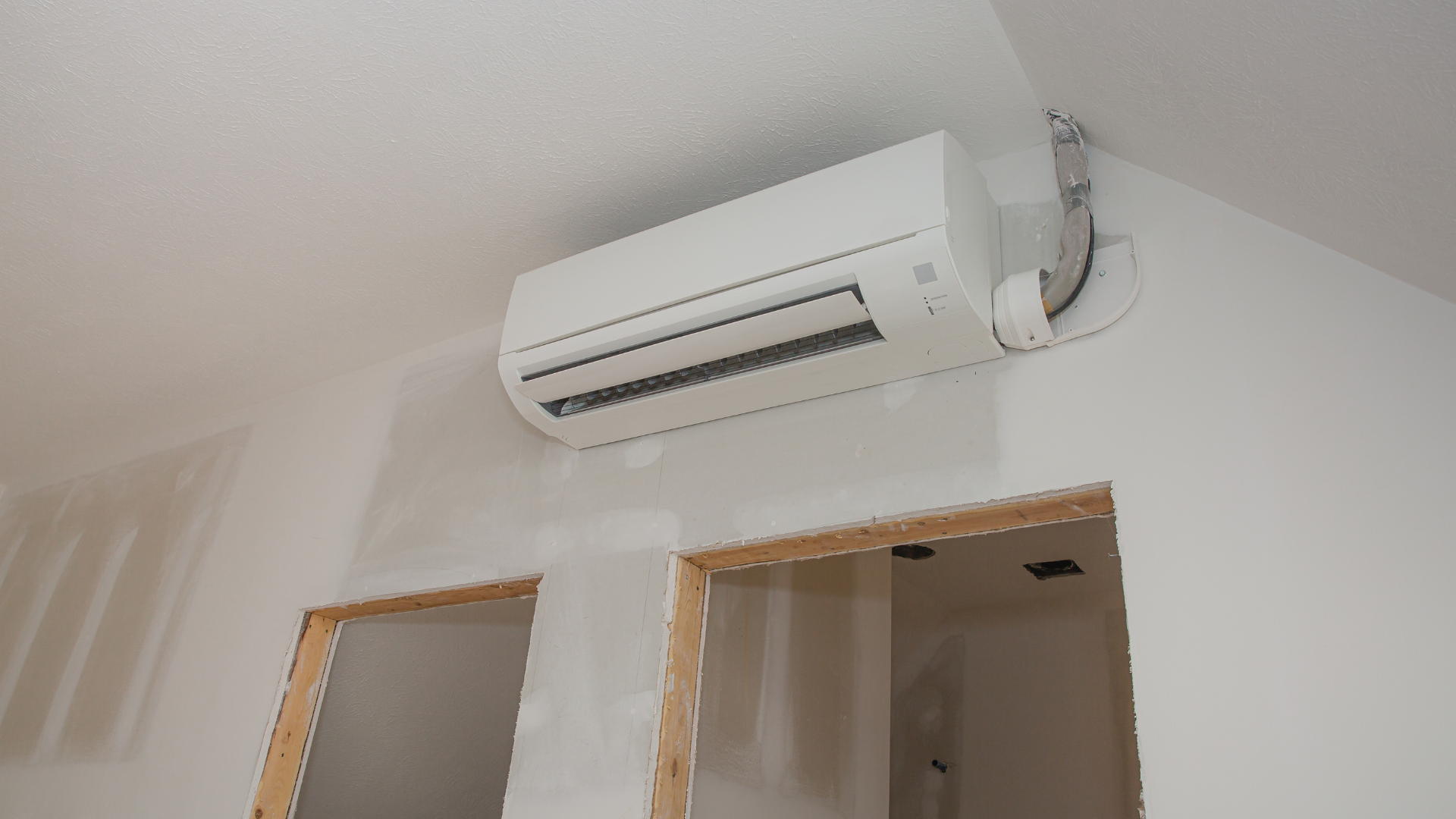
One outdoor condenser serving one indoor unit. This is the standard solution for a single problem room — a hot bedroom, a loft office, a conservatory-adjacent living space — and it is the most cost-effective way to fix one specific comfort problem.
Because the pair is matched, single splits tend to run efficiently at part load and are simple to service. Where two rooms need cooling but sit far apart, two single splits are sometimes a better answer than one multi-split with long pipe runs.
One outdoor unit serving several indoor units, each individually controlled. Multi-splits suit properties where two to five rooms need cooling and where a single outdoor unit is preferable — for space, appearance or planning reasons.
The trade-off is that all indoor units share one condenser, so capacity and pipe runs have to be planned as a whole. Getting that wrong produces a system where the furthest room underperforms whenever the others are running.
Wall-mounted units are the most common and the most cost-effective, and they suit the majority of domestic rooms. Where a wall position is unworkable or visually unacceptable, floor-standing and ducted or concealed options exist, though they cost more and require more building work.
Position matters as much as style. An indoor unit needs unobstructed airflow across the room and a sensible return path, and it should not blow directly onto a bed or a desk chair. Those decisions are made at survey, with you, rather than on installation day.
Systems installed are likely to be Daikin, Toshiba, Samsung or Midea. The choice follows the application: available capacities at the size the room needs, indoor unit dimensions for the wall available, sound levels where a bedroom or a neighbouring boundary is a factor, and control options if the household wants scheduling or app control.
Inverter-driven units are standard on modern domestic systems. Rather than switching on and off at full output, they modulate compressor speed to match demand, which is both quieter and substantially cheaper to run than older fixed-speed equipment.
Refrigerant pipework is insulated copper, run with the interconnecting cable and condensate drain along an agreed route — internally through voids and cupboards where possible, or externally in trunking where it is not. Wall penetrations are cored, sealed and made good.
Each system needs an appropriate electrical supply, and where an outdoor unit sits on a wall it needs brackets rated for it, with anti-vibration mounts to keep structure-borne noise out of the building. These are the details that separate an installation that disappears into the house from one you notice every time it runs.
Domestic installation is the core of what we do — homes, home offices, loft conversions and extensions across Basingstoke, Hook, Hartley Wintney, Tadley, Andover, Kingsclere, Overton, Micheldever and Aldermaston.
Once installed, a system needs annual servicing to hold its output and air quality: filters, coils, condensate route and operating pressures all need attention. Air conditioning servicing is offered as a separate service so systems keep performing rather than quietly degrading year on year.
Questions
Anything not covered here, call 07825 758511 and ask. 8am–5pm, Monday to Friday, with out-of-hours emergency call-outs available.
Domestic installations start from £1,600 + VAT. The final figure depends on the capacity required, the number of indoor units, pipework route length and the outdoor unit position. The survey is free and the written quote is fixed once issued.
A single-split system in a straightforward position is usually a one-day installation. Multi-split systems and longer or more awkward pipework routes take longer, and the quote sets out the expected programme before you commit.
Yes. Modern split systems are heat pumps and reverse to provide heating, which is efficient and particularly useful in shoulder seasons or in rooms the central heating struggles to serve.
Most domestic installations fall within permitted development, but there are conditions relating to the position and size of the outdoor unit, and different rules apply to listed buildings and conservation areas. The outdoor unit position is discussed at survey so this is settled before installation.
Modern inverter systems are quiet in normal operation. Noise is mostly a siting question — where the outdoor unit goes relative to bedroom windows and boundaries, and whether it is mounted with anti-vibration measures. Both are planned at survey rather than resolved afterwards.
Capacity is calculated from the room's heat gain: dimensions, glazing area and orientation, insulation, occupancy and any equipment load. Sizing by floor area alone commonly produces units that are too small to cope or too large to dehumidify properly.
Systems are likely to be Daikin, Toshiba, Samsung or Midea, chosen to suit the room, the capacity needed and any noise constraints rather than a single default supplier.
Yes — F-Gas certified under Refcom REF1025590. Refrigerant handling is legally restricted work. The business is also Gas Safe registered under 593588 and holds £2 million public liability insurance.
The equipment carries its manufacturer's warranty, and our installation work carries a one-year workmanship guarantee. Systems need annual servicing to keep performing, which we also provide.
Basingstoke and north Hampshire, including Hook, Hartley Wintney, Tadley, Andover, Kingsclere, Overton, Micheldever and Aldermaston.
Next step
Free survey, capacity calculated from your room rather than guessed, and a written price from £1,600 + VAT that does not move once accepted.