Full cooling output restored
Clean filters and coils return airflow and heat rejection to specification, which is usually the difference between a room that cools and a room that only takes the edge off.
Cooling · Basingstoke & north Hampshire
An annual service by an F-Gas certified engineer keeps your system delivering the cooling capacity you paid for, keeps the air it circulates clean, and catches the small faults that turn into compressor failures.
F-Gas certified Refcom REF1025590 · 15 years qualified · £2 million public liability · one-year workmanship guarantee
Domestic AC servicing to keep output, efficiency and air quality where they should be.
15 years qualified
Apprenticeship completed 2011
Gas Safe 593588
Registered engineer
F-Gas certified
Refcom REF1025590
£2 million cover
Public liability insured
Fixed quotes
Free, and fixed once given
Overview
Air conditioning degrades gradually and invisibly. Filters load with dust, indoor and outdoor coils foul, the condensate route silts up and refrigerant charge can drift. None of it announces itself — the system simply takes longer to cool the room each summer, and the electricity it consumes to do so creeps upwards.
A service reverses that. Filters and coils are cleaned, the condensate route is cleared and proved, electrical connections and controls are checked, and the system's operating performance is verified in both cooling and heating so any drop in capacity is identified rather than tolerated.
It is also the visit where the air quality side gets attention. An indoor unit circulates the room's air through a wet coil and a filter, and a neglected unit will hold dust and biological growth that ends up in the air you breathe. That is the part people notice most immediately once it has been dealt with.
The cost of leaving it
A blocked filter is the first domino. Restricted airflow across the indoor coil drops the coil temperature, which causes icing, which drops output further and returns liquid refrigerant towards a compressor designed to handle gas. Compressor damage is the single most expensive failure a split system can suffer, and it is regularly the end of the system rather than a repair.
The outdoor coil does the same thing from the other end. Choked with dust, pollen and debris it cannot reject heat, so head pressure rises, efficiency collapses and the compressor works harder and hotter for the same cooling. You pay for that in electricity long before anything breaks.
The condensate route is the failure that damages the building rather than the system. A silted drain backs up into the indoor unit and overflows down the wall — usually behind or below the unit, so the first sign is staining, blown plaster or a damp patch on a ceiling.
And a dirty, damp indoor unit is a biological problem as much as a mechanical one. Dust and moisture on a coil support growth, and that growth ends up in the air of the room the system serves — commonly a bedroom.
Our process
A consistent inspection and clean of both units, finished with a performance check.
01
Filters are removed and cleaned or replaced, the coil, fan and blower are inspected and cleaned, and the casing and grilles are checked for dust build-up and any sign of biological growth.
02
The drain pan and condensate line are cleared and proved to run freely, and any pump is tested. This is the check that prevents water damage to the wall and the room below.
03
The condenser coil is cleaned of dust, pollen and debris, fan operation is checked, clearances are confirmed and mountings, brackets and anti-vibration measures are inspected.
04
Electrical connections, isolation and controls are checked, and system operating pressures and temperatures are assessed for any sign of refrigerant loss. Refrigerant work is carried out under F-Gas certification Refcom REF1025590.
05
The system is run in cooling and heating and the delivered performance is verified rather than assumed. You get a plain summary of condition, anything that needs attention, and what it would cost — with no work started unasked.
Benefits
The capacity you paid for, held where it should be.
Clean filters and coils return airflow and heat rejection to specification, which is usually the difference between a room that cools and a room that only takes the edge off.
A fouled system draws more electricity for less cooling. Cleaning the coils and confirming correct operation is the cheapest efficiency measure available to an existing system.
Filters and the indoor coil are the two places dust and growth accumulate, and they are both dealt with — which matters most in bedrooms and home offices.
The condensate pan, drain and any pump are cleared and proved, so the system does not discharge into your wall during the first hot week.
Airflow restrictions, icing and refrigerant loss are the three things that kill compressors, and all three are checked at every service.
F-Gas certified Refcom REF1025590, £2 million public liability insurance, and a service record you can produce for a warranty claim. Work carries a one-year guarantee.
In detail
What actually degrades, how you can tell, and what maintenance differs between system types.
Filters are the owner's job between services and should be checked monthly through the cooling season — they slide out of the indoor unit and rinse clean. Everything else needs an engineer, because the indoor coil and blower wheel sit behind the filter and accumulate a film that no amount of filter cleaning reaches.
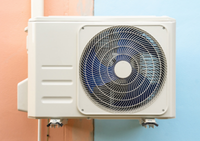
The outdoor coil is exposed to whatever the garden produces: pollen in spring, dust in summer, leaves in autumn. Cleaning it and maintaining the manufacturer's clearances around the unit is what allows it to reject heat at the rate the system was designed around.
A sealed refrigerant circuit should not lose charge. If a system is short on refrigerant, there is a leak, and repeatedly topping it up is both an environmental problem and a way of paying for the same fault every year while the compressor runs undercharged.
The service checks operating pressures and temperatures for the signature of undercharge. Where a leak is indicated, it is traced and repaired under F-Gas certification, then the system is evacuated and correctly recharged rather than simply topped up.
An indoor unit in cooling mode produces a continuous flow of water. Gravity drains need consistent fall the whole way to their termination; where the unit's position makes that impossible, a condensate pump is used and becomes another component that needs testing annually.
Silting in the drain pan is normal over a year, particularly on a unit that is also collecting dust. Clearing it is routine at service and it is the reason the majority of AC water damage incidents never happen to serviced systems.
A single split has one indoor and one outdoor unit, so the service is straightforward. A multi-split shares one condenser across several indoor units, which means each indoor unit needs individual attention and the shared outdoor unit carries proportionally more load.
On multi-splits it is also worth checking that every indoor unit is performing, because a household will often only notice degradation in the room they use most while another unit has been underperforming for a season or more.
Because modern split systems reverse to provide heating, many are now in use year-round rather than for eight weeks each summer. That doubles the running hours and makes annual maintenance more, not less, relevant.
In heating mode the outdoor unit becomes the evaporator and will defrost periodically, discharging water at its base. Ensuring the unit is mounted with drainage and clearance in mind stops that becoming an ice problem in cold weather.
Servicing covers domestic systems across Basingstoke, Hook, Hartley Wintney, Tadley, Andover, Kingsclere, Overton, Micheldever and Aldermaston, whoever originally installed them.
Because the business is both F-Gas certified and Gas Safe registered, an air conditioning service can be booked alongside an annual boiler service — or a landlord gas safety certificate at £90 + VAT — so the property's maintenance happens in one visit rather than three.
Questions
Anything not covered here, call 07825 758511 and ask. 8am–5pm, Monday to Friday, with out-of-hours emergency call-outs available.
Servicing is quoted for your system and property, and quotes are free and fixed once given. Where work is charged by time rather than by quote, the rate is £90 + VAT per hour.
Annually, ideally in spring before the cooling season. If the system is also used for heating through winter, its running hours are far higher and annual servicing matters more, not less.
The usual causes are loaded filters, a fouled indoor or outdoor coil restricting airflow and heat rejection, or refrigerant loss from a leak. A service identifies which applies rather than leaving you guessing.
Almost always a blocked condensate drain or a failed condensate pump, so the water that the unit normally drains away backs up and overflows. It is a straightforward fix and it is exactly what annual servicing prevents.
Yes, and you should — monthly through the cooling season. But the coil, blower wheel, condensate pan and outdoor coil sit beyond the filter and need an engineer, and refrigerant checks legally require F-Gas certification.
Yes. We service domestic split and multi-split systems regardless of who installed them or which brand they are.
Icing means either airflow is restricted — a blocked filter or dirty coil — or the system is low on refrigerant. Both need dealing with promptly, because running an iced system returns liquid refrigerant toward the compressor and that is the most expensive component to lose.
Manufacturers generally require documented maintenance for warranty cover to remain in force. Servicing is recorded so you have that evidence if you need to claim.
Yes — F-Gas certified under Refcom REF1025590, with £2 million public liability insurance. The business is also Gas Safe registered under 593588 for gas work.
Yes. Being both Gas Safe registered and F-Gas certified means heating and cooling maintenance, including a landlord CP12 at £90 + VAT where relevant, can be handled in a single appointment.
Next step
Filters and coils cleaned, condensate proved, performance verified in cooling and heating. One visit, and the system delivers what it was installed to deliver.