Strong flow at every outlet
Mains-pressure hot water means showers perform properly upstairs and downstairs, without a pump making up for gravity that was never there.
Plumbing · Basingstoke & north Hampshire
Mains-pressure hot water supplied, installed and maintained so two showers can run at once without either one dropping — no loft tanks, no pumps, no waiting for the cylinder to catch up.
Gas Safe registered 593588 · 15 years qualified · £2 million public liability · one-year workmanship guarantee
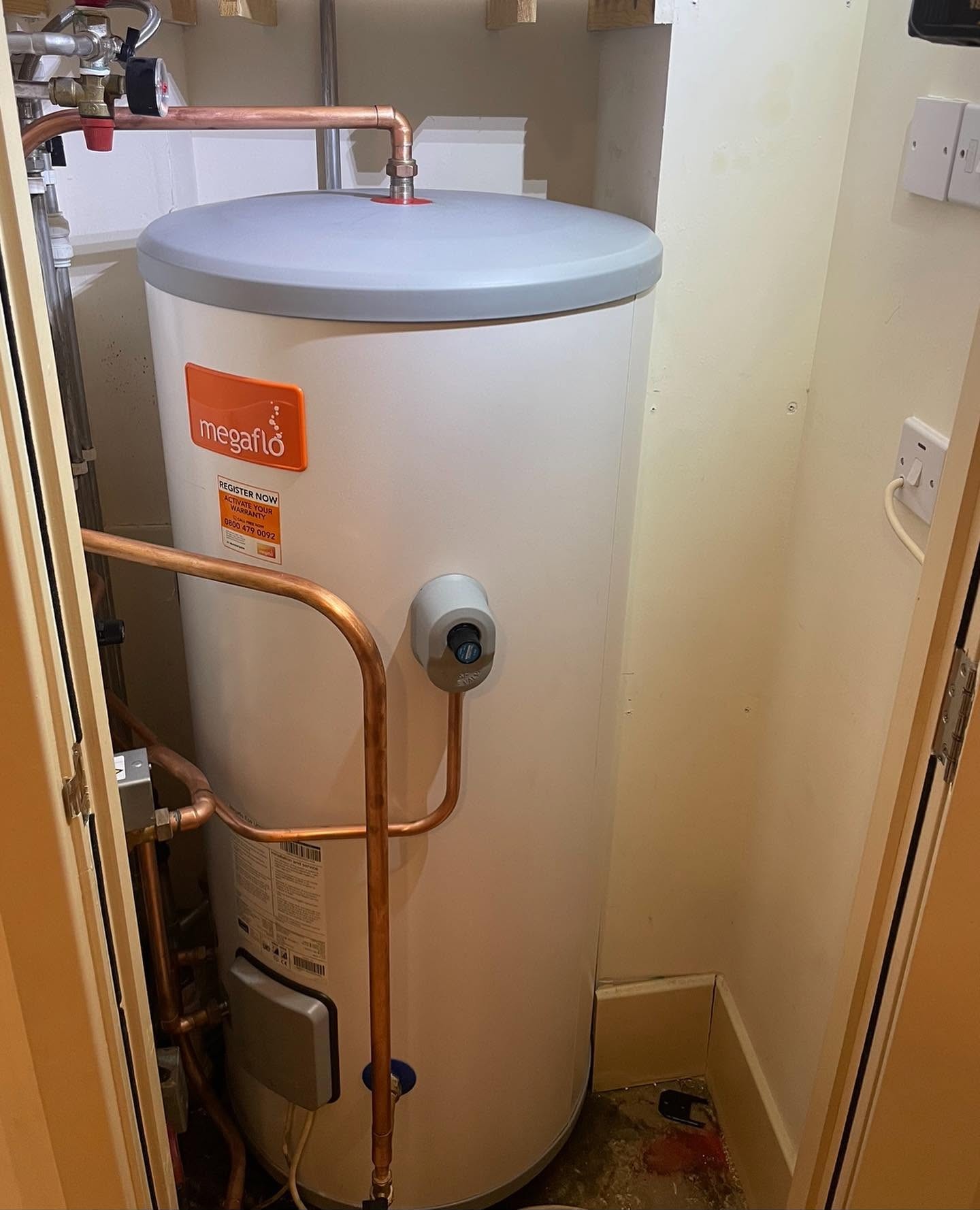
Mains-pressure hot water cylinders supplied, installed and maintained for strong flow at every outlet.
15 years qualified
Apprenticeship completed 2011
Gas Safe 593588
Registered engineer
F-Gas certified
Refcom REF1025590
£2 million cover
Public liability insured
Fixed quotes
Free, and fixed once given
Overview
An unvented hot water cylinder is fed directly from the incoming mains rather than from a cold tank in the loft. Because it is pressurised at mains pressure, the hot water arriving at your taps and showers is at the same pressure as the cold — which is what produces a shower that behaves like a shower rather than a trickle governed by how high the loft tank happens to sit.
That single change removes a long list of the old system's problems: the loft tank and its overflow, the pipework losing heat in the roof space, the reliance on gravity for pressure, and the shower pump added to compensate for it. It also frees the loft, which is why unvented cylinders are standard on modern installations and on almost every renovation that touches the hot water.
The trade-off is that a pressurised vessel of stored hot water is a system that has to be installed and maintained correctly. It contains safety components — expansion vessel, pressure and temperature relief, tundish and discharge — that exist to manage stored energy, and they need annual attention rather than being fitted and forgotten.
The cost of leaving it
An unvented cylinder has safety components with a job to do, and those components fail quietly. The expansion vessel loses its air charge over time, and once it has, every heating cycle pushes expanded water out through the pressure relief valve instead of absorbing it. You see that as intermittent dripping at the tundish, which most households ignore for months.
That dripping is not harmless. It means the relief valve is operating repeatedly, which wears the seat until the valve no longer seals at all, at which point you have a continuous discharge of heated mains water going down a drain and onto your bill. Replacing an expansion vessel is cheap; replacing a cylinder because nobody investigated the drip is not.
Old vented systems have their own escalating problems. Loft tanks are open to the roof space, which means dust, insects and eventually contamination. Tank overflows and ballvalve failures in an unheated loft are also a reliable source of the kind of water damage that runs through two floors before anyone notices.
And the ordinary daily cost is simply the one people put up with: a shower that drops the moment someone runs the kitchen tap, a second bathroom that is effectively unusable while the first is in use, and a household organising itself around the hot water instead of the other way round.
Our process
Measured, specified, installed and commissioned with the safety components proved.
01
Incoming mains pressure and flow rate are measured — the single most important number, because a cylinder cannot deliver more than the mains can supply — alongside outlet count, household usage patterns, available space and the discharge route.
02
You get the cylinder size and type, the heat source arrangement, the pipework and discharge plan and a fixed price. Free to obtain, fixed once accepted. Where a direct or indirect cylinder, or a different capacity, changes the outcome, you see the options side by side.
03
The old cylinder and, where applicable, the loft tank and its pipework are removed. The new cylinder is positioned and secured, primary and secondary pipework is run, and the expansion vessel, relief valves, tundish and discharge pipe are installed to the required route and termination.
04
The system is filled and pressure tested, the expansion vessel charge is set, relief valves are proved, and the operating and stored temperatures are set correctly. Everything is checked under real demand rather than assumed to work.
05
You are shown the controls, the isolation points and what the tundish is telling you if it ever drips. The installation carries our one-year workmanship guarantee alongside the cylinder manufacturer's warranty, and you are told when the annual service is due.
Benefits
Hot water that behaves the way the household actually needs it to.
Mains-pressure hot water means showers perform properly upstairs and downstairs, without a pump making up for gravity that was never there.
Stored hot water is what allows a shower and a bath, or two showers, to run simultaneously — the thing a combi boiler cannot do regardless of its output.
No cold water storage tank, no feed and expansion tank, no overflow, and no pipework losing heat in a cold roof space.
Capacity is specified from the number of outlets and the household's real usage, so you neither run out mid-shower nor pay to store water nobody uses.
Expansion vessel, relief valves, tundish and discharge installed correctly, commissioned properly, and checked annually rather than left until something drips.
Boiler, heating and hot water designed and installed together, with Gas Safe registration 593588, £2 million public liability and a one-year workmanship guarantee.
In detail
The technical decisions that determine whether hot water is a solved problem or a daily irritation.
An indirect cylinder is heated by a coil carrying hot water from the boiler — the standard arrangement in any property with gas central heating and a system boiler. A direct cylinder heats the stored water with immersion heaters alone, which is used where there is no boiler or as a backup arrangement.
Twin-coil cylinders take two heat sources, which matters where a second input such as a future renewable heat source is planned. Specifying the coil arrangement at installation is much cheaper than changing the cylinder later.
Cylinder sizing is a balance between stored volume and reheat time. Too small and the household runs out during a normal evening; too large and you pay standing losses to keep water hot that nobody uses, and the reheat cycle takes longer than it needs to.
The honest inputs are the number of bathrooms, how many people use hot water in the peak hour, whether baths or showers dominate, and the boiler output available to reheat the cylinder. Those numbers, not a generic table, decide the specification.
An unvented cylinder carries an expansion vessel to absorb the expansion of heated water, a pressure relief valve, a temperature and pressure relief valve, and a tundish with a discharge pipe routed to a safe, visible termination. These are not optional accessories — they are the system that manages stored energy safely.
The tundish is deliberately visible so that any discharge can be seen. A tundish that drips intermittently after heating cycles is telling you the expansion vessel has lost its charge; a tundish that runs continuously means a relief valve has failed to reseat. Both need attention rather than a bucket.
An unvented cylinder delivers hot water at mains pressure, which means it can never deliver more flow than the incoming mains provides. If the property's supply is poor, fitting a mains-pressure cylinder will disappoint, and the honest conversation is about the supply rather than the cylinder.
That is why flow rate and pressure are measured at survey. Where the mains genuinely cannot support the demand, alternatives such as an accumulator or a different system design are the correct answer, and saying so up front avoids an expensive disappointment.
Unvented cylinders need annual attention. The expansion vessel charge is checked and re-pressurised, relief valves are tested and proved to reseat, the discharge route is inspected, temperature controls and thermostats are verified and the immersion heater is checked where fitted.
The most common repairs follow directly from those checks: expansion vessel replacement, relief valve replacement after repeated operation, thermostat and control failures, and immersion heater replacement. Each is a modest job caught early and a much larger one left alone.
Stored hot water pairs with a system boiler, which is why cylinder work usually forms part of a boiler installation or a full central heating installation rather than sitting on its own. Specifying both together avoids the classic mismatch of a high-output boiler feeding an undersized cylinder, or the reverse.
We install and maintain cylinders across Basingstoke, Hook, Hartley Wintney, Tadley, Andover, Kingsclere, Overton, Micheldever and Aldermaston, including in older properties where the change from a vented, tank-fed layout involves reworking pipework that has been extended piecemeal over decades.
Questions
Anything not covered here, call 07825 758511 and ask. 8am–5pm, Monday to Friday, with out-of-hours emergency call-outs available.
It depends on the cylinder size and type, the pipework and discharge route, and whether an old cylinder and loft tank need removing. Every job is surveyed and given a free written quote that is fixed once issued.
A vented cylinder is fed by a cold tank in the loft and relies on gravity for pressure, so upstairs outlets are weak. An unvented cylinder is fed directly from the mains and delivers hot water at mains pressure, so showers perform properly on every floor and the loft tanks disappear.
It depends on the number of bathrooms, how many people draw hot water in the peak hour, whether the household takes baths or showers, and the boiler output available to reheat it. The survey establishes those figures rather than applying a generic rule.
Intermittent dripping after the cylinder heats usually means the expansion vessel has lost its air charge. Continuous discharge usually means a relief valve has failed to reseat. Both should be dealt with promptly — a worn relief valve seat turns a cheap repair into an expensive one.
Yes, annually. The expansion vessel charge, relief valves, discharge route, thermostats and controls all need checking. It is a pressurised vessel of stored hot water, and the safety components exist to be maintained.
It delivers hot water at mains pressure, which is a substantial improvement over a gravity-fed tank. But it cannot exceed what the incoming mains supplies, which is why flow and pressure are measured before anything is recommended.
That is exactly what stored hot water at mains pressure is for, provided the cylinder is sized correctly and the mains supply supports the flow. It is the main practical advantage over a combi boiler.
Yes. That is one of the most common jobs on this service — removing the cylinder, the cold water storage tank and the associated pipework, and installing a mains-pressure unvented cylinder in its place.
A straightforward cylinder replacement is typically a day. Converting from a vented, tank-fed system involves more pipework and the removal of loft tanks, so it usually takes longer. The quote sets out the programme beforehand.
A one-year workmanship guarantee on the installation, plus the cylinder manufacturer's warranty on the unit itself. The business is Gas Safe registered 593588 and carries £2 million public liability insurance.
Next step
Free survey with your mains flow and pressure actually measured, and a written price that does not move. If your supply will not support it, we will tell you before you spend anything.